Peter Pinguid Society
The Crying of Lot 49The Peter Pinguid Society is a San Narciso political organization whose history and practice join two forms of resistance: opposition to industrial and state power, and the maintenance of private channels of communication. Through its spokesman Mike Fallopian, the Society presents the past as a contested struggle over authority and the mail as a practical arena in which that struggle continues. Its clandestine delivery arrangement becomes one of Oedipa Maas’s first concrete encounters with the pattern she will pursue as the Tristero mystery develops.
Identity and Historical Namesake
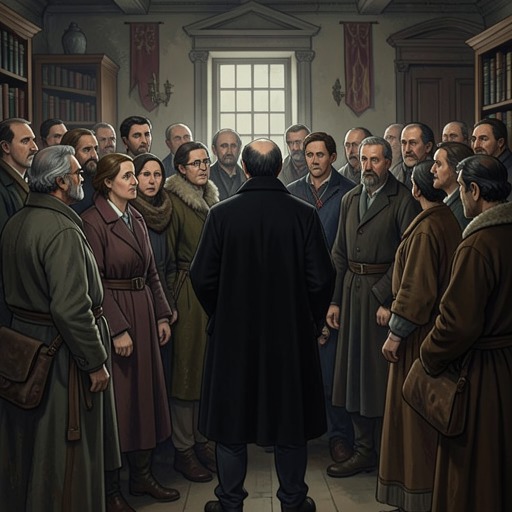
The Society is introduced when Mike Fallopian, a frail young man in a drip-dry suit, sits down with Oedipa and Metzger and begins advocating for the organization. Metzger tests whether it is a right-wing group; Fallopian says it is accused of being paranoid, while Oedipa’s brief question about who “they” and “us” are leaves the group’s boundaries intriguingly unsettled. The Society’s name invokes Peter Pinguid, a Confederate commodore whose abortive voyage gives the organization a founding story that is less settled than a conventional heroic legend.
According to Fallopian’s account, Pinguid set out in 1863 aboard the man-of-war Disgruntled, intending to lead a force around Cape Horn to attack San Francisco and open another front in the War for Southern Independence. Storms and scurvy reduced the expedition until the Disgruntled alone reached the California coast about a year later. The scene was complicated by a Russian Pacific squadron sent to San Francisco Bay under Rear Admiral Popov, amid rumors that Confederate cruisers might attack the city. On March 9, 1864, a Russian ship—possibly the corvette Bogatir or the clipper Gaidamak—sighted the Disgruntled off a stretch of coast that the account cannot identify with certainty. The ships may have exchanged fire, but neither bore evidence of damage. By morning the Russian vessel had disappeared; an account attributed to one of the Russian ships’ logs instead claimed that the Disgruntled had vanished.
Fallopian stresses that the Society does not treat this uncertain encounter as scripture, even though March 9 is sacred to its members. He says the group’s reluctance to turn the story into unquestionable doctrine has cost it support in the Bible Belt, where its Confederate association might otherwise have appealed. The episode is important less as a securely reconstructed battle than as an origin story whose competing versions exemplify the Society’s suspicion of settled political accounts.
Politics and Interpretation
Fallopian calls the encounter the first military confrontation between Russia and America: an attack and possible retaliation, with both projectiles lost to the Pacific. In his telling, the historical event’s consequences exceed what can be proved about the ships themselves; its ripples have widened into the present. He also describes Pinguid as the Society’s first casualty, but not because he was killed in the encounter. Fallopian considers his subsequent withdrawal into weeks of brooding a worse fate. Appalled by what he understood as an alliance between abolitionist Russia and a Union that professed abolition while permitting industrial workers to live under what Fallopian characterizes as wage slavery, Pinguid retreated to his cabin.
Metzger challenges the Society’s political fit: opposition to industrial capitalism, he argues, would seem to disqualify Pinguid as an anti-Communist figure. Fallopian rejects the assumption that opposition to capitalism makes someone a Marxist. He says the Society opposes both industrial capitalism and Marxism, treating them as parts of the same advancing horror rather than as cleanly opposed alternatives. When Metzger suggests that the group objects to industrialization itself, Fallopian accepts the point. The exchange presents the Society’s politics as deliberately resistant to the usual division into political camps, though the novel supplies this position through Fallopian’s advocacy rather than through an independent account of the organization’s membership or platform.
Private Mail and Organizational Practice
The Society’s opposition to government control of communication takes material form in its mail service. Oedipa first notices a latrine-wall advertisement inviting readers to contact someone named Kirby “through WASTE only,” alongside an unfamiliar symbol. When Fallopian returns, he says she was not supposed to see the notice and shows her an envelope bearing the handstruck initials PPS in place of a postage stamp. Metzger infers that the Society would oppose the government’s postal monopoly; Fallopian replies that its method is less openly rebellious than it appears.
The San Narciso chapter uses Yoyodyne’s inter-office delivery system without authorization. Fallopian says that finding carriers is difficult because the work is tightly scheduled, the carriers are nervous, and the plant’s security personnel are alert to irregularities. One carrier, De Witt, has been especially nervous. The operation is local rather than a fully established national network: Fallopian says that comparable pilot projects exist in the Washington and, he thinks, Dallas chapters, while San Narciso is the only chapter in California using one. Some wealthier members instead wrap letters around bricks, cover them in brown paper, and send them by Railway Express, a workaround Fallopian regards as a retreat from the principle of the Society’s own service.
To keep the clandestine system active at a reasonable volume, every member must send at least one letter a week through Yoyodyne’s internal route or be fined. Fallopian shows Oedipa and Metzger an example of the routine correspondence: a short note asking after his book and suggesting a meeting at The Scope. Its ordinary, almost contentless message contrasts with the risk and discipline involved in sending it. The quota is not merely an ideal; it is an internal rule backed by a penalty, binding members to use the channel even when they have little to say.
Mail History and Inventors
Fallopian is writing a history of private mail delivery in the United States, an intellectual project that connects the Society’s practice to a longer conflict over public authority and private competition. He is trying to link the Civil War with postal reform beginning around 1845. In his interpretation, it is more than coincidence that the federal government acted vigorously in 1861 to suppress surviving independent routes, after a series of laws in 1845, 1847, 1851, and 1855 had been designed to make private competition financially unviable. He sees the pattern as a parable of power: its accumulation and systematic abuse.
The organization’s critique also extends to the corporate workplace. Fallopian describes engineers who were taught to admire the lone American inventor—Morse, Bell, Edison, and even Tom Swift—but later found that their Yoyodyne contracts required them to surrender patent rights in inventions they might create. Stanley Koteks voices the immediate grievance: the contract, he says, stifles creative engineers. Fallopian interprets this not as an isolated labor dispute but as the production of anonymity: workers are absorbed into projects and task forces, assigned a role in procedures already laid down, and deprived of the individual authorship they had been taught to value. He supposes that such engineers recognize one another and keep in touch, imagining an underground of people made bitter by the same system. Oedipa, listening to the dispute, begins to feel that a pattern concerning the mail and its delivery is emerging.
Narrative Significance
The Society’s mail service is an early, tangible link between political dissent and the signs Oedipa is collecting. The Kirby notice joins the word WASTE to the unfamiliar symbol she copies into her notebook; Fallopian’s PPS-marked envelope confirms that the Society has a covert delivery practice, but does not by itself establish that the Society controls every channel or symbol Oedipa encounters. That distinction matters: the organization offers a real example of private communication operating beside official systems, while Oedipa is still trying to decide how far separate clues belong to one network.
Fallopian’s history also places the Society within a broader sequence of private carriers and state suppression. Later, Emory Bortz describes Tristero refugees reaching America in 1849–50 after postal reform had weakened independent routes, then remaining in a clandestine position as the federal government continued to suppress competitors. He depicts their later methods as emphasizing silence, impersonation, and opposition disguised as allegiance. That account makes the Society’s concern with postal monopoly resonate with the larger Tristero story, but it does not make the two organizations interchangeable. The Society is significant both as a political group with its own rules and as one of the first settings in which the novel turns private delivery from an abstract historical issue into a present, working system.